How to Get the Spain Digital Nomad Visa in 2025 Step-by-Step

If you’re reading this, chances are you’re imagining a life where work doesn’t feel like you’re chained to a desk in one place. You’re earning in dollars or another strong currency, yet you want more than just income - you want time, space, and the freedom to choose your home base. Spain has become Europe’s top destination for remote professionals - combining affordability, safety, and a lifestyle most people only dream about. With year-round sunshine, centuries of culture, world-class healthcare, and a lifestyle built around community and balance rather than stress and hurry, Spain offers one of the most fulfilling environments in Europe for remote professionals.
This article is your ultimate step-by-step guide to the Spain Digital Nomad Visa - how to qualify, what documents you need, how the process works, what life looks like when you get there and how to avoid the most common mistakes that trip people up. Whether you’re a U.S. employee working remotely for a foreign company, a freelancer servicing clients globally, or a business owner seeking a European base, you’ll find valuable information here for 2025 and beyond.
What is the Spain Digital Nomad Visa?
Spain introduced its digital nomad visa under its Startup Act in January 2023. What it does is simple: it allows non-EU citizens to live in Spain while working remotely for a company outside of Spanish territory or as a freelancer/self-employed professional with non-Spanish clients.
The main benefit is that you can live in Spain legally while continuing your remote work. You keep your income and stability, but gain a lifestyle many only dream of - beach days, sunshine, culture, and weekend trips around Europe.
Unlike many other digital nomad visas in Europe, Spain’s version also offers a clear path to long-term residency after five years and even citizenship after ten, making it one of the most valuable remote-work visas available today.
There are two main application paths you can take:
Path A – Applying from outside of Spain: You apply through a Spanish consulate in your home country. If approved, you receive a visa valid for initially one year. You can then enter Spain and register for the residence permit.
Path B – Applying from within Spain: You travel to Spain as a tourist and apply online via the UGE (Unidad de Grandes Empresas) from within Spain. This way if you have an indefinite contract with your company you can get a 3-year permit upfront.
Which one is better depends on your situation. However, we advise all our clients to apply from within Spain, as this route is faster - approved within 20 business days, and if no response is given, it’s automatically granted under Spain’s positive administrative silence rule - far less bureaucratic, and allows you to secure a three-year residence permit instead of just one. You can settle in, get your documents in order, and start enjoying life here without the long wait times and paperwork delays that often come with applying through a consulate abroad.
Who Can Apply for the Spain Digital Nomad Visa?

Reach out to Move to Europe to explore your pathway to living and working in Spain.
To qualify for the Spain Digital Nomad Visa (DNV), you must meet specific personal, professional, and financial criteria. These requirements are specifically designed to ensure that remote professionals can support themselves while living in Spain and that their work activity remains outside the Spanish economy.
Let’s start with the general eligibility requirements and then look at them in more detail.
Basic eligibility criteria
You are a non-EU/EEA citizen (citizens of the U.S., UK, Canada, Australia, etc. qualify).
You work remotely - either as an employee for a company outside Spain, as a freelancer with international clients, or as a business owner who serves clients primarily abroad.
Your company (or your main client’s company) must have been operating for at least one year prior to your application.
You must be able to prove that your role or business can be performed 100% remotely.
You have not been resident in Spain during the previous 5 years under a similar visa type.
There are three ways to qualify for the Digital Nomad Visa:
Remote employees
You are employed by a non-Spanish company and have been working with them for at least three months prior to applying.
Freelancers or independent contractors
You work for one or several companies as a contractor.
Business owners
You own your own company abroad (for example, an LLC in the U.S. or a Ltd in the UK).
What Are The Financial Requirements for the Spain Digital Nomad Visa?
Spain wants to ensure that digital nomads are financially self-sufficient and contributing positively to the economy. The minimum income thresholds are tied to the national minimum wage and updated annually.
Minimum income requirement as of 2025
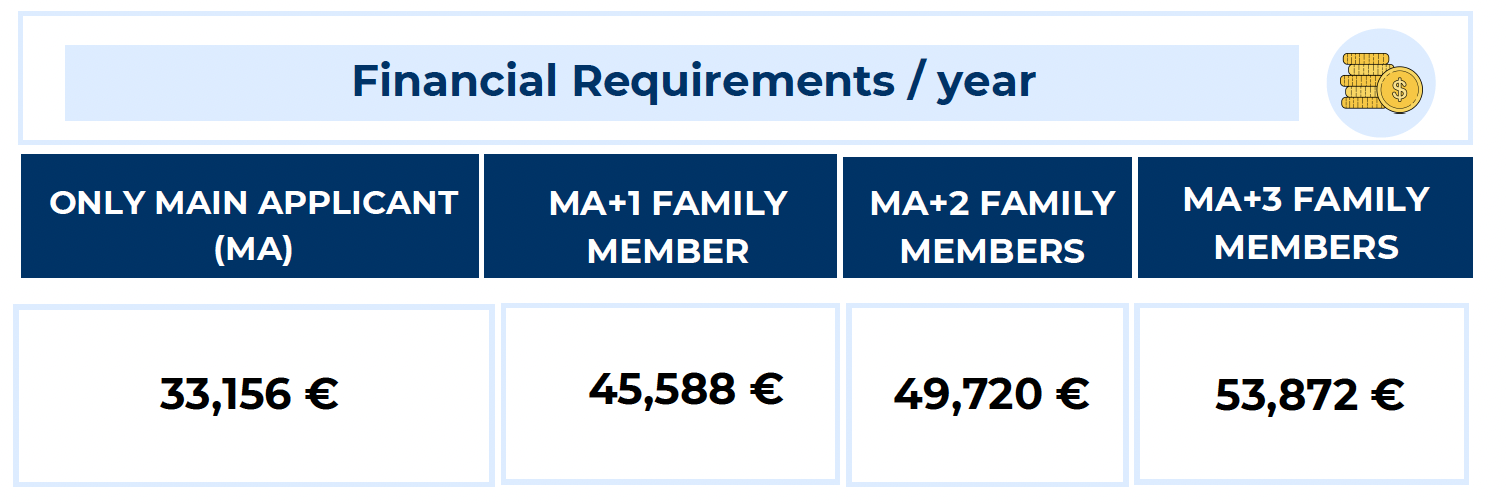
As of 2025, the threshold is 200% of Spain’s minimum wage, which equals:
€2,763 gross per month (or €33,156 gross annually) for the main applicant.
+€1,035 per month (approx. 75% of the main applicant’s requirement) for a spouse or partner.
+€690 per month (approx. 25%) for each dependent child.
These figures must be shown in gross income, not net.
How to prove your income
You can demonstrate financial eligibility through the following documents:
Payslips from your employer for the last 3 months (for employees).
Bank statements showing salary deposits or client payments for the last 3 months.
Tax returns or business income statements (for freelancers or business owners).
Savings and passive income
If your active income falls slightly below the threshold, you may offset it with:
Savings account statements for the past 6 months.
Dividend or rental income statements (can supplement your application, but your primary income (90-95%) must come from active work).
Keep in mind: this visa is intended for active professionals, not retirees. If most of your income is passive (dividends, rentals, pensions), consider the Non-Lucrative Visa instead.
How to Prove Your Professional Experience for the Spain’s Digital Nomad Visa?

Beyond income Spain’s Digital Nomad Visa requires applicants to prove their professional qualifications. This step ensures that applicants are genuinely skilled professionals capable of maintaining stable, remote work from Spain.
To be eligible, you must demonstrate that you have the skills and background to perform the remote work you claim to do. You can meet this requirement in one of two ways:
Hold a university degree (bachelor’s or higher from an accredited insitution) related to your current professional activity; or
Show at least three years of verifiable work experience in your field.
This rule applies to every applicant, regardless of whether you’re an employee, freelancer, or business owner.
➙ When to submit a degree:
If your degree aligns with your current line of work, it provides a simple path. For example:
A marketing degree for a digital marketing specialist.
A computer science or IT degree for a software engineer or web developer.
A business or finance degree for a consultant or strategist.
Your diploma must be officially translated into Spanish and apostilled (for U.S. applicants, by your state’s Secretary of State).
➙ When to submit three years of work experience
If your degree isn’t related to your current profession - or you don’t have one - you can still qualify through your work history. You’ll need to show at least three years of proven professional experience in your field.
Acceptable evidence includes:
Employment verification letters or certificates from previous employers.
Signed contracts and invoices from clients.
Tax returns or annual income statements showing activity in the same field.
Recommendation letters that describe your role, tasks, and duration of work.
⚠️ Important: It’s no longer sufficient to provide just recommendation letters or employer certificates. For U.S. citizens, tax returns remain the most reliable proof. For UK citizens, you must also obtain an official employment history record from HM Revenue & Customs (HM RC)
Complete Document Checklist for the Spain Digital Nomad Visa ✅

Now that you understand the professional and financial criteria, let’s go over every document you’ll need for a successful application.
This list covers general documentation for all applicants, plus specific requirements for employees, freelancers, business owners, and dependents. All public documents expire quickly - they’re valid for 6 months if applying from within Spain through the UGE, and only 3 months if applying through your home consulate. Always double-check issue dates before submitting.
General Documents (Required for All Applicants)
Valid Passport - Must be valid for at least one year from the date of application. Scan all pages individually, including the page with the entry stamp to Spain if applying from within the country.
Application Form (MI-T) - Completed and signed.
Administrative Fee Payment (Modelo 790 – Code 052) - approximately €73.26.
Criminal Record Certificate - For all countries you’ve resided in during the last 2 years. Must be apostilled and sworn-translated into Spanish.
Sworn Declaration of Absence of a Criminal Record - A simple signed statement confirming you have no criminal record within the last five years in Spain or any other country.
Proof of Financial Means - Bank statements or payslips for the last 3 months showing income meeting the current DNV threshold.
Professional Proof - Degree or work-experience documents as outlined before.
Résumé (CV) - Simple version in Spanish.
Proof of Accommodation in Spain - Hotel booking, short-term lease, or address from friends or family needed for the MI-T Form.
➙ Specific Documents For Remote Employees
Employment contract (preferably open-ended).
Letter of authorization from employer confirming remote work from Spain.
Certificate of incorporation or good standing for the employer company (at least 1 year of operation, apostilled and sworn translated).
Certificate of Coverage confirming continued social-security contributions in your home country (apostilled and sworn translated).
Proof of Health Insurance – Private insurance covering the entire stay in Spain with no deductibles or co-pays.
➙ Specific Documents For Independent Contractors
Signed contract with at least one corporate client (not individuals).
Invoices and matching bank statements covering at least 3 months.
Certificate of incorporation of the client company (at least 1 year of operation, apostilled and sworn translated)
Letter of authorization from the client confirming your ongoing collaboration.
A signed statement that you will enroll into Spanish Social Security System.
➙ Specific Documents For Business Owners
Certificate of incorporation and tax registration proof (apostilled and sworn translated).
Articles of incorporation showing company structure and ownership (apostilled and sworn translated).
Business tax returns for the last 1-2 years (apostilled and sworn translated).
Proof of social-security contributions if you have employees (apostilled and sworn translated).
Invoices and matching bank statements covering at least 3 months.
Letter of authorization from a co-owner or company representative.
A signed statement that you will enroll into Spanish Social Security System.
These are the core documents usually required, though Spanish officers may request additional evidence at their discretion to verify your company’s legitimacy.
💡 For U.S. applicants: There is a viable workaround for business owners whose company primarily serves individual clients (B2C). If you own an LLC, you can apply as a contractor of your own company, paying yourself through 1099 income and providing invoices and tax returns as proof of business activity. This approach allows you to meet the Digital Nomad Visa requirements while maintaining your existing business structure. Contact us so that we can help you create a compliant setup.
Documents for Family Members
One of the biggest advantages of Spain’s Digital Nomad Visa is that it allows you to bring your immediate family members with you. You can include your spouse or registered partner, children, and even elderly parents, as long as you can prove they are financially or medically dependent on you. Adult children up to age 25 may also be included if they are financially dependent and live with you.
To include dependents in your application, you’ll need the following:
Marriage certificate and/or birth certificates of children, apostilled and sworn-translated into Spanish.
MI-F form for each dependent.
Administrative-fee payment for each dependent.
Criminal-record certificate for each family member aged 18 or older.
Sworn Declaration of Absence of a Criminal Record - A simple signed statement confirming you have no criminal record within the last five years in Spain or any other country.
Proof of additional income covering dependents - 75% of the main applicant’s requirement for a spouse or partner, and 25% for each child.
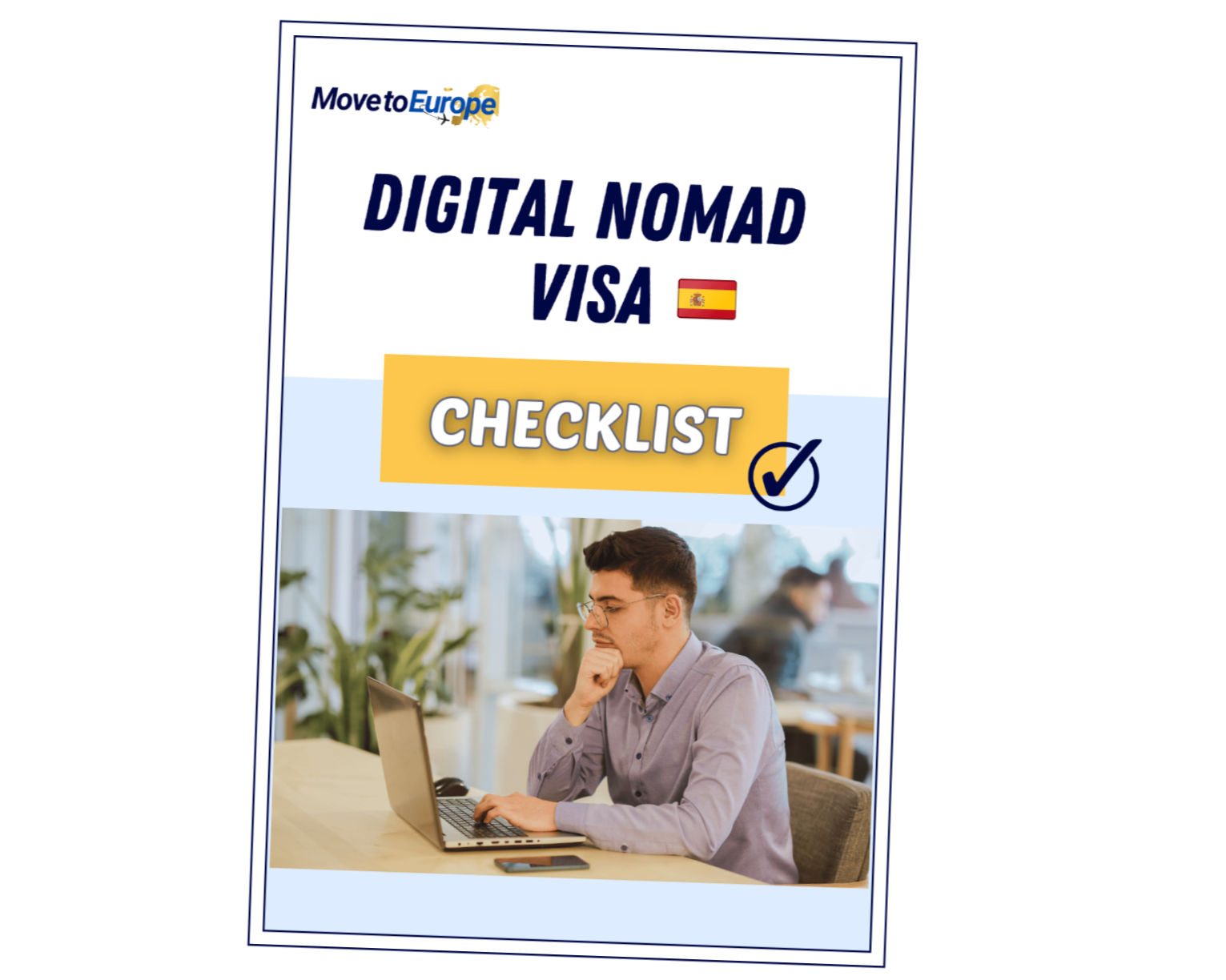
To make this process easier, download my free, printable Digital Nomad Visa Checklist - it includes every required document and lets you track your progress step by step.
What Happens After Your Digital Nomad Visa Is Approved?
Receiving your Digital Nomad Visa approval is an exciting milestone, but it’s not the final step. The approval notice itself is not yet proof of residency and does not allow re-entry into Spain if you leave the country. Once approved, you must complete the final stage of the process - obtaining your TIE (Tarjeta de Identidad de Extranjero), Spain’s physical residence card.
You’ll need to book an appointment at your local Oficina de Extranjería or police station, bring your approval letter, passport, photos, and proof of payment for the Modelo 790 (code 012) fee. After submitting fingerprints, your TIE card will be ready in about 3-4 weeks. Only once you hold your TIE are you officially registered as a Spanish resident and free to travel in and out of the country. Don’t leave Spain before obtaining your TIE - your visa approval letter alone isn’t valid for re-entry.
Spain Digital Nomad Visa: FAQs
How long does the Spain Digital Nomad Visa take to process?
If you apply from within Spain through the UGE (Unidad de Grandes Empresas), the decision is typically made within 20 business days. If no response is issued in that period, it’s automatically approved under Spain’s positive administrative silence rule. Applications submitted through a Spanish consulate abroad generally take longer - often 1 to 3 months.
Can I apply for the Spain Digital Nomad Visa while already in Spain?
Yes. You can apply from within Spain as long as you entered legally - for example, with a tourist visa or visa-free entry. This route is often faster because the residence authorization is granted for three years instead of one. The application is submitted online through the UGE platform, and approval is usually processed much quicker than at a consulate.
How much income do I need for the Spain Digital Nomad Visa?
As of 2025, you must earn at least €2,763 gross per month (around €33,156 per year). If you are applying with dependents, you’ll need an additional €1,035 per month for a spouse or partner and €690 per month for each child. This income must come primarily from remote work or business activity outside Spain.
Can couples combine their income to meet the Spain Digital Nomad Visa requirements?
No. For the Spain Digital Nomad Visa, only the main applicant’s income counts toward the minimum income requirement. The household’s combined income cannot be used.
Can unmarried couples apply for the Spain Digital Nomad Visa together?
Unmarried couples can apply together only if their partnership is legally recognized, such as being registered as pareja de hecho in Spain or another country. Otherwise, each partner must apply separately, though one can later apply for family reunification after receiving their own residence card.
Will I owe local taxes in Spain if I have the Spain Digital Nomad Visa?
Yes, if you spend more than 183 days per year in Spain, you become a Spanish tax resident. Remote employees may qualify for the Beckham Law, which allows a flat 24% tax rate on Spanish-source income and exemption from global income for up to six years. However, self-employed workers, freelancers, and business owners are not eligible and must follow Spain’s progressive tax system.
Do I have to stay in Spain for a certain amount of time with the Spain Digital Nomad Visa?
Yes. To maintain your residence status, you must spend at least 183 days per year in Spain. Extended absences could risk losing your residency status or interrupt the timeline toward permanent residency and citizenship.
Does the Spain Digital Nomad Visa lead to permanent residency and citizenship?
Yes. After five consecutive years of legal residence, you can apply for permanent residency. After ten years, you may be eligible for Spanish citizenship, provided you’ve maintained continuous residence and met the legal requirements. Citizens of Latin American countries that were formerly Spanish colonies may qualify for citizenship after two years.
Get Expert Help with Your Move to Spain
Applying for Spain’s Digital Nomad Visa is more than just collecting paperwork - it’s the foundation of your new life abroad. But between gathering documents, managing translations, understanding tax obligations, and securing housing or healthcare, the process can quickly become overwhelming. One small mistake can delay your approval or force you to start over.
At Move to Europe, we’ve helped dozens of remote professionals and families relocate to Spain with confidence. We’re not a visa factory - our team provides high-touch, white-glove service and personally guides you through every stage, from your onboarding call to the moment you’re fully settled in Spain. We handle the process end-to-end so you can focus on your work and enjoy the excitement of starting a new chapter, with peace of mind that all the complexity will be handled for you.
If you’re serious about moving to Spain and want a seamless, stress-free experience, we can help you do it right from the start. Click below to explore how we work and learn more about our premium relocation services.