How to Get Spanish Residency - TIE Card & Next Steps Explained

You’ve finally received your approval for the Spain Digital Nomad Visa or Non-Lucrative Visa - a moment that feels like the start of a new chapter. But once you land in Spain, the real transition begins. Your visa approval is just the entry point; turning that approval into actual legal residency requires several more steps.
Once you understand the order of operations, the process becomes much more straightforward. In this guide, I’ll walk you through everything you need to do after arriving in Spain. This includes how to register your Spanish address, register as autónomo, obtain your TIE residence card, open a bank account, and set up your healthcare. It’s designed to help you avoid costly mistakes, reduce stress, and make your first months in Spain smooth and predictable.
1. Register Your Address (Empadronamiento)
Your first major task after arriving in Spain is completing your empadronamiento, also known as registering your address. This step is absolutely essential, because nearly every other administrative process depends on it. Your TIE card, healthcare registration, schooling, and local services all require this certificate.
What is Empadronamiento?
Empadronamiento is the official registration of your home address in the municipal registry (padrón municipal de habitantes). It formally connects you to your city or town and provides proof that you reside at that address.
Where to Register for Empadronamiento?
You register at your Ayuntamiento (Town Hall) or a designated municipal office, depending on the city. In larger cities like Valencia, Málaga, or Madrid, there are multiple offices and each neighborhood organizes its own padrón appointments.
What You Need to Bring for Empadronamiento
Requirements vary by municipality, but you will generally need:
Your passport
Your NIE number (either on the visa sticker or listed in your visa resolution letter)
Your signed rental contract (minimum 6 months)
Proof of rent payment or a utility bill showing your name at the address
The request form “Hoja de empadronamiento” (required in some cities such as Málaga and Alicante)
Some municipalities also request a copy of your landlord’s DNI/NIE (common in Valencia and Alicante).
Others require a signed authorization form called “Autorización para empadronar al inquilino” (frequent in Málaga and Alicante).
You can usually download all required forms from your local Town Hall website (Sede Electrónica).
How Long It Takes to Get Empadronamiento in Spain?
Appointments are usually available within a few days or weeks, depending on the city. The registration itself is typically completed during your appointment. You will leave with either:
a printed padrón certificate, or
instructions to download it digitally within 24-48 hours
The certificate is generally valid for three months, so don’t wait too long before completing the next steps that require it.
Your empadronamiento registration itself remains valid for two years. After that, you must renew it - typically online through your digital certificate or Cl@ve system.
Why Do You Need Empadronamiento?
Your empadronamiento is required for:
Applying for your TIE card
Accessing the public healthcare system
Enrolling children in public schools
Signing up for municipal services
Many tax, banking, and legal processes
Without it, you cannot move forward with the majority of residency procedures.
However, if you are living in another province (for example, Valencia), you cannot bypass your local requirements by applying for your TIE in Madrid. You must complete your TIE process in the city where you actually reside.
We still recommend completing your empadronamiento regardless of your location, as it is one of the most important documents in Spain for proving continuous residence. This record is often required later if you apply for permanent residency or, in certain cases, fast-track Spanish citizenship after two years for nationals of eligible Iberian or Ibero-American countries.
2. Setting Up Banking and Finances

Start with an online bank like N26, Nickel, or Bunq to get a fast Spanish IBAN without extensive paperwork or long in-branch appointment delays.
Opening a bank account is a crucial step in settling into your life in Spain. You will need a Spanish account for virtually everything:
Paying rent
Setting up utilities
Registering as autónomo if applies (self-employed)
Paying local taxes
Receiving payments
Signing up for public services
Many newcomers run into the classic issue: banks want proof of address to open an account, but landlords want a Spanish bank account to rent to you.
Best temporary solution? Start with an online bank such as N26 or open a non-residential bank account in BBVA or Sabadell. These banks accept foreign residents, let you open accounts remotely or with minimal documentation, and quickly provide a Spanish IBAN. This IBAN is enough to secure your rental.
Once you have your TIE card and padrón, you should switch to a residential bank account at a Spanish local bank such as: CaixaBank / BBVA / Santander / Sabadell.
Traditional banks offer mortgage products, loans, and broader services that may be useful later.
How to Transfer Money from the U.S. to Spain
If your income comes from the U.S., services like Wise offer far better conversion rates and lower fees than traditional international transfers. You’ll use this frequently, so it’s worth setting up early.
3. Registering as Autónomo in Spain
(Self-Employed Digital Nomad Visa Holders Only)
⚠️ This step applies only to Digital Nomad Visa holders who applied as self-employed.
If your DNV was approved under an employment contract, or you got a different type of visa - you can skip this section.
If you were approved for the Digital Nomad Visa as a freelancer, contractor, or business owner, registering as autónomo is a mandatory next step once you have a Spanish address and bank account.
When Should You Register as Autónomo in Spain?
Autónomo registration should be completed as soon as possible after your Digital Nomad Visa is approved, once you have secured a Spanish address and opened a Spanish bank account. In practice, this usually means registering before or shortly after your TIE appointment.
Although Spanish law does not set a specific deadline for this step, working as a self-employed Digital Nomad in Spain without being registered as autónomo means you are not complying with the conditions of your visa. This can create serious problems later on.
If autónomo registration is delayed, it can lead to backdated tax and social security payments, penalties, and complications during future Digital Nomad Visa renewals. In more serious cases, continued non-compliance can result in the cancellation of your residency authorization.
For this reason, autónomo registration should be treated as an urgent post-approval requirement, not something to postpone until you are fully settled in Spain.
How to Register as Autónomo in Spain?
Step 1 → Register with the Spanish Tax Agency (Agencia Tributaria)
The first step is registering your professional activity with the Agencia Tributaria. This is where you declare what type of work you will be performing in Spain, select the appropriate tax categories, and formally notify the tax authorities that you will be operating as a self-employed professional.
Step 2 → Register with Social Security (Seguridad Social)
Once your tax registration is completed, you must register with Seguridad Social under the self-employed system (RETA). This step activates your monthly social security contributions and creates or links your Spanish social security number (NAF).
Step 3 → Begin Working Legally and Access Public Services
After both registrations are finalized, you are legally authorized to work in Spain under your Digital Nomad Visa. At this stage, your monthly social security contributions begin, starting with a reduced flat rate (tarifa plana), which is currently €87 per month during the first year for new autónomos.
After the initial reduced period, your contributions are calculated based on your declared income, following a progressive system - meaning the more you earn, the more you contribute. This contribution system is what grants you access to Spain’s public services.
Once registered with Social Security, you also become eligible for Spain’s public healthcare system. In many cases, immediate family members (such as a spouse or dependent children) can be enrolled under your social security coverage and gain access to public healthcare as well.
4. Apply for Your Residence Card
(TIE – Tarjeta de Identidad de Extranjero)
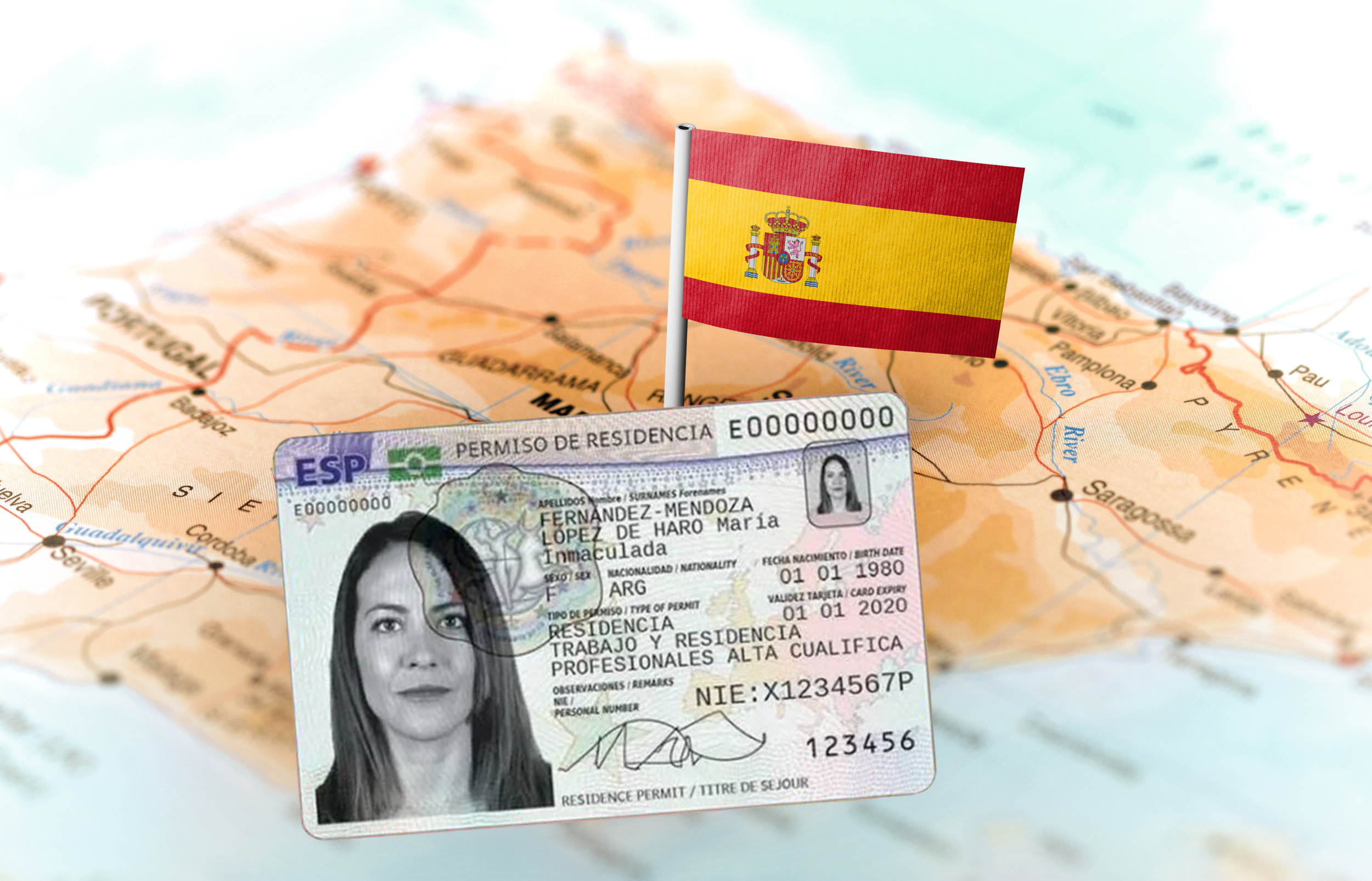
Once your address is registered, your next priority is obtaining your TIE card - your physical Spanish residency card. This is one of the most important documents you will ever receive during your move.
What Is the TIE?
The TIE is the official identification card for non-EU residents living in Spain. It contains your name, photograph, NIE number, residency type, and validity dates.
Most importantly, it becomes your primary ID within Spain, meaning you do not need to carry your passport everywhere.
When Should You Apply for the TIE?
By law, you are expected to initiate the TIE process within 30 days of entering Spain. However, in practice, this timeline is far more flexible because securing an appointment (cita previa) often takes several weeks - especially in cities like Valencia, Málaga or Barcelona.
Spanish authorities understand this reality. What matters is that you actively try to book an appointment and complete the process as soon as you reasonably can. You will not be penalized if you are unable to obtain an appointment within the 30-day window due to lack of availability.
How to Book Your TIE Appointment (Cita Previa)
TIE appointments must be booked online through Spain’s official government system, the Sede Electrónica (Extranjería). You must select your province and then choose the correct procedure: “Toma de huellas (Expedición de tarjeta de identidad de extranjero)” (This is the correct option for fingerprinting and issuing your first TIE card.)
To book an appointment, you will need:
Your NIE number (found on your visa sticker or resolution letter)
A Spanish phone number (to receive verification codes during the booking process)
An email address
⚠️ The system sometimes shows “no appointments available,” especially in cities like Valencia, Málaga, Barcelona, and Madrid. This is normal. Appointments are released unpredictably throughout the day and often require checking multiple times daily. However, since January 2026, there have been significant improvements to the platform, and we are seeing more appointments available for booking.
What to Bring to Your TIE Appointment
You will need:
Your passport
Your empadronamiento certificate
Your Visa approval resolution
Completed EX-17 form
Payment receipt for the Modelo 790 - Código 012 fee
A Spanish ID size passport photo
During the appointment, the officer will take your fingerprints. They will give you a receipt known as a resguardo, which confirms you have applied for your card.Keep in mind: this visa is intended for active professionals, not retirees. If most of your income is passive (dividends, rentals, pensions), consider the Non-Lucrative Visa instead.
When You Receive Your TIE
Your card is generally ready within 30-45 days. You must return to the same office to pick it up in person. Once you have it, you are officially a resident of Spain and can enter and leave the country freely without depending on tourist-day limits.
5. Accessing Healthcare in Spain

Once you’ve settled into your new home and completed your initial residency steps, the next important stage is understanding how healthcare works in Spain and registering for the system that applies to you. Healthcare is a core part of becoming a resident, and Spain’s system is one of the reasons many people choose to build their lives here.
Spain runs a dual healthcare system, meaning there is both a public option and a private one. Most residents - including locals - rely on a combination of the two during their first months or even long-term.
The public healthcare system, known as Seguridad Social, provides access to high-quality medical care that is free at the point of service for eligible residents. Eligibility depends on your situation. Employees are automatically enrolled through payroll contributions, while self-employed residents (autónomos) join the system through their monthly social security payments. Family members may also qualify through a contributing relative.
Once you’re enrolled in Social Security, you can register at your local Centro de Salud, the public health center assigned to your neighborhood. To do this, you typically need your Social Security number (known as your NAF), your padrón certificate showing your registered address, and your passport or TIE. After registering, you’ll be assigned a primary care doctor (médico de cabecera) and will receive your public health card, the Tarjeta Sanitaria (SIP), which you’ll use at public clinics and hospitals.
Alongside the public system, Spain also has a strong private healthcare sector, which many expats choose to use - especially during their first year in Spain. Private insurance is very affordable compared to the U.S., and most plans cost between €40 and €90 per month. The main advantages are faster access to specialists, shorter waiting times for tests, the option to choose your doctor or hospital, and a higher likelihood of finding English-speaking medical staff. It’s also often required for certain visas, including the Non-Lucrative Visa.
Because of these benefits, I personally recommend keeping a private health insurance plan even if you qualify for the public system. It offers peace of mind, quicker appointments, and more flexibility while you’re adjusting to life in Spain. Later on, once you’re fully settled and familiar with how everything works, you can decide whether you want to rely on the public system alone or continue with both.
6. Getting Residency in Spain: FAQs
Get Expert Help with Your Move to Spain
Moving to Spain isn’t just about getting a visa approved - it’s about arriving legally, getting settled properly, and staying compliant once you’re here. From securing the right visa to handling post-arrival steps like your TIE card, address registration, banking, healthcare, and tax or autónomo setup - we help with entire relocation process.
At Move to Europe, we’ve helped dozens of remote professionals and families relocate to Spain with confidence. We’re not a visa factory - our team provides high-touch, full relocation service and personally guides you through every stage, from your onboarding call to the moment you’re fully settled in Spain. We handle the process end-to-end so you can focus on your work and enjoy the excitement of starting a new chapter, with peace of mind that all the complexity will be handled for you.
If you’re serious about moving to Spain and want a seamless, stress-free experience, we can help you do it right from the start. Click below to explore how we work and learn more about our relocation services.
